|
The
Bf 109-G6 is one of the most easily recognizable variants
in the 109 lineage.
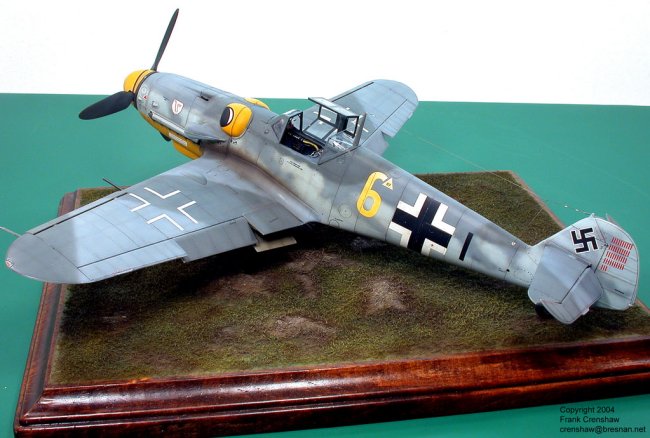
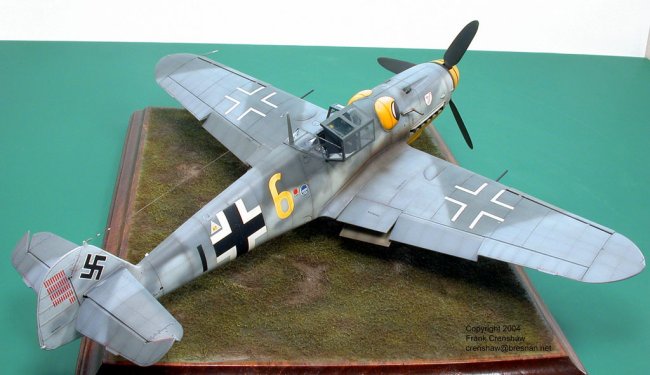
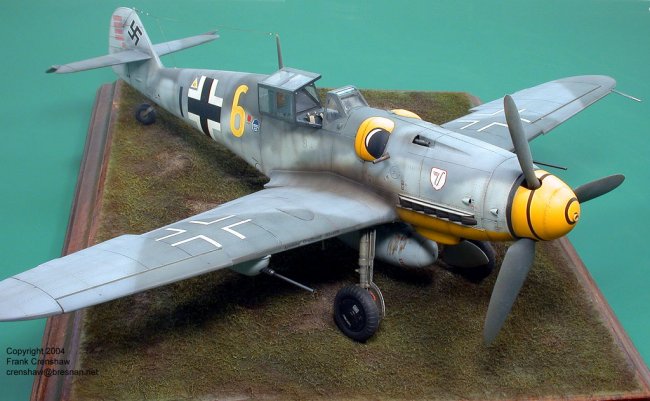
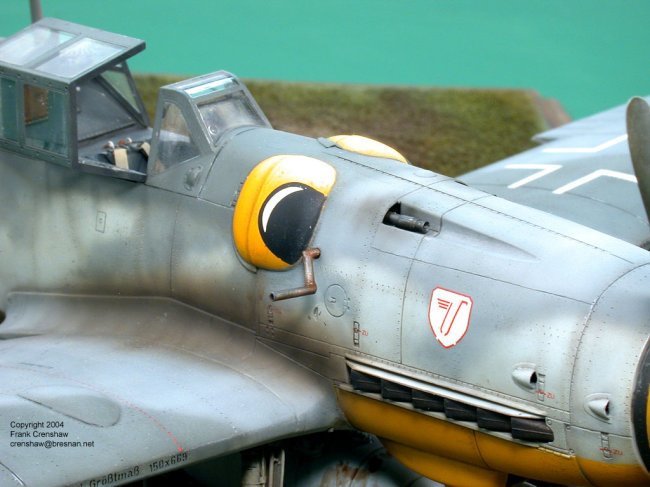
This model represents the colorful mount of
9/JG
3 pilot Alfred Sarau in
fall of
1943,
as it would appear just before a mission. This plane represents a fairly early
G-6 model. It carries a simplified camouflage splinter of RLM 74 gray-green, RLM
75 violet gray over RLM 76 Blue. It carries the FuG 16 zy antenna mounted under
the fuselage, rather than out on the wing as seen in many later examples.
It is also equipped with the FuG
25a antenna just under the cockpit.
On
October 14, 1943 Sarau took off in this bird to engage 8th AF bombers that
were headed to strike the
Ball Bearing factories at Schweinfurt. Some
60 Bombers would be shot down
that day , a heavy price ,
but the Luftwaffe took hits as
well .
Sarau was one of those shot
down and killed in the fighting that day. While the allied losses were quickly
replaced, the Luftwaffe wasn’t so lucky.
|
Click on
images below to see larger images
|
|

|
|

|
This
is the 1/32 scale Hasegawa Bf-109G-6 almost out of the box,
but with some minor details
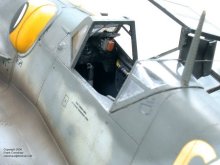
added. The cockpit was
built essentially OOB. Being dark, there isn’t much visible in there,
so the the cockpit is actually pretty good right out of the box. I carefully
shaved the raised detail off the instruments on the instrument panel. I used my
Waldron Model Products punch and die sets (I have both sets) to punch the
individual instruments faces from the kit supplied decal sheet and placed them
on the corresponding bezel on the panel. I
then gave each instrument face a coating of Future floor wax.
In retrospect I wish I had added some wiring to enhance the pit .
I scratch built a seat backing by vacforming over an aluminum master, then
adding the side and top pieces with strip styrene.
I scratch built the seatbelt mounting points on the rear of the cockpit
from brass wire, using super glue to build up the shape that was shown in my
reference books. I used the
Eduard 1/32 scale Luftwaffe seatbelts, and they are magnificent; I
usually don’t like etched belts because they tend to look too “stiff, ”
but these belts were fantastic. I painted the belts Pollyscale Dirty white and
the lap pads Pollyscale Kaki. I also added a leather-securing strap to the
compartment hatch on the rear of the cockpit made from paper with snaps punched
from styrene.
The
covers in the rear of the landing gear bay were made from thin copper sheeting
glued to the sidewall, with snaps punched from styrene.
The zipper in the cover was made by running a pounce wheel over thin
aluminum, and cutting out a thin strip were the indentations are.
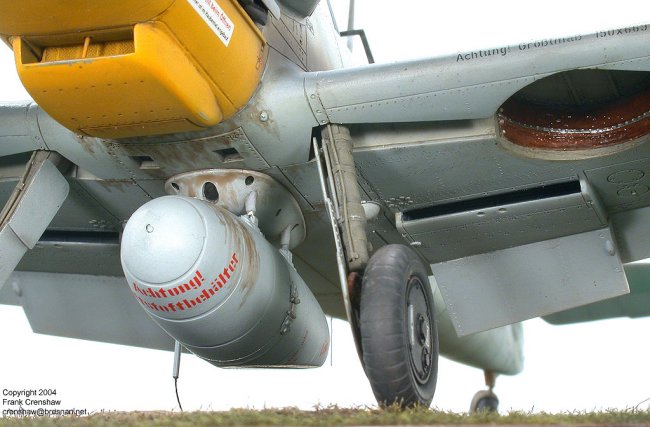
The gear doors were thinned to look more realistic, and some detail was
added as per my references. The
flexible rubber brake hoses were added between the tires and the struts, and the
tires
were flattened a bit to
look more realistic. I used a scriber to trace around the bracket on the rear
tailwheel to make a cut that gives the effect of the parts being separate. This
gives a very good impression of a tailwheel and totally negates the need to
replace the part, and best of all it’s very easy to do.
I cut the tailwheel bracket and added a support post made from brass rod
and glued it back on so that it was turned to one side (these planes had a free
floating tailwheel and it could be turned almost any direction
as the ground crew moved the plane– even backwards). The exhausts
were hollowed out using my dremel tool;
this really improves their look.
I added a strap to the drop tank made
from thin aluminum, and scratch built a starter crank from styrene rod to finish
off the model.
Rivet
detail was added by
using a pounce wheel. I mixed up Tamiya paint to paint the base colors of
RLM 74, RLM 75, and RLM 76. I
do not pre-shade, but instead post shade. This involves using variations of the
base colors to change the coloring of the base colors. Sort of doing a glaze
wash using your airbrush. I
work around the panel lines to accent the rivets, panels, and use contrasting
tones of glaze. This results in a pleasing and realistic looking weathering
effect that is very subtle.
Once
the painting was completed, the model was given a coat of Future
floor wax . I used the Microscale
finishing system to apply the Eagle Cal decals. Their
decals are thin, and of very high quality, and went on with no trouble at all.
After the decals were finished I did my weathering – which consisted of adding
the exhaust stain, an enamel wash of burnt umber and black, and chipping using a
silver artist pencil. The oil
streaks were added last using brown ink.
I really enjoyed this model; it made me fall in love with 1/32 scale
hard. I have plans to do many other 109s, and am hopeful that there will be
other subjects released of the caliber of this kit in the future.
Frank
here
is a link to a photo of the prototype http://www.messerschmitt-bf109.de/pics-bf109g/bf109g6r6_026-swfoto.jpg
|
|