|
In
june 1982, I had the pleasure to meet Colonel Avi. Bobby BLADT who was the
leader of the belgian Red Devils aerobatic team , while flying on Hawker Hunters
out of Chièvres Air base in Belgium. The Red Devils are known for their
performances , of course , but also for their beautifully red painted Hawker
Hunters (see ARC Gallery Hawker Hunter articles).
As
I had heard of standard camouflaged aircraft wearing the belgian colors under
the wings, and seen a very little picture of a nine aircraft formation during a
meeting taken in 1958 ( among wich four aircraft seamed to have tricolored
painted wings) I asked Bobby Bladt
if he knew anything about that. The colonel told me story.
The
Chièvres team ...Red Devils forerunners
In
1956/1957 , fierce competition had been running between Belgian Air Force wings
to have an aerobatic team who would represent Belgium during international
airshows. The 7th Wing , flying Hunters out of
Chièvres was chosen against the Beauvechain 1st Wing and the Bierset 9
Wing teams also flying Hunters. The Chièvres team was under leadership of Major
Robert “Bobby” Bladt, wing commander flying of the base. He was already
known for his “Acrobob” team flying Gloster Meteors in the early fifties out
of Beauvechain AB.
The
“Meeting des Nations” ( Nations airshow) held on 28 june at Bierset AB
at the occasion of the Universal Exposition held in Brussels had seen
all the best aerobatic teams of Nato performing, like the USAFE Skyblazers, La
Patrouille de France, the Italian "Diavoli Rossi", British
"Black Arrows", Greek "Skyblazers",the Portuguese and
Turkish teams. All of these teams had brightly painted aircraft
except the Belgians who performed "anonimously" with 5
aircraft painted in standard camouflage. This led for some frustration among
Belgian pilots The leader, with the support of the 7 th Wing commander
,Lt. Col. de Bueger ,decided to have some camouflaged planes painted
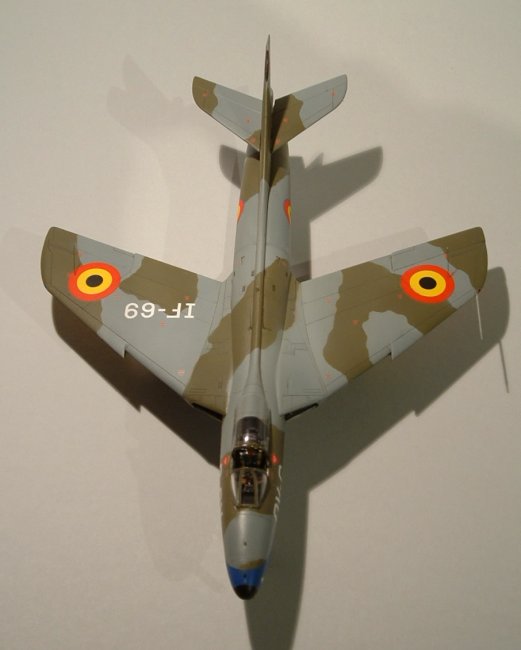
with the belgian colors under the wings “ à la Patrouille de France”
("like those of the French team", as Col Bladt said to me) for an
airshow held in Chièvres on 10 october 1958. Bobby Bladt told me these paints
were a great success but the initiative was not liked by the BAF HQ who soon
ordered to have them removed.
Birth
of the red Devils
Due
to popularity, the Hunter team (who now flew with nine
aircraft) had to answer an increasing number of invitations to perform
at many airshows across Europe and the PRO of the Belgian Air force,
Major Houart, asked to find a name for the team. By analogy
with the national football team the team was officially
given the name “Les Diables Rouges/ De Rode Duivels” (The Red
Devils), symbol on national unity ( hence the bilingual name )and team
spirit. The national football team also provided the badges of the
“rampant lion” on the right pocket of the flying suits. The 1959
season closed by an airshow in Beauvechain and for unknown and
unexpected reasons, the HQ decided to disband the team. Maybe one of the
reasons could have been the fear from HQ to have all Chièvres Hunters
performing as one team as the 1959 season saw the Red Devils performing
with an increasing number of aircraft, (culminating with16 ! ) or some
air/air collisions that occured during practice.
|
Fortunately
,this decison was cancelled in early 1960 but permission was given to
perform only with a 4 aircraft team. At last the HQ also authorised 6
aircarft to be painted in a flamboyant signal red scheme and the all red
Hunters appeared for the first time in public on 7 may 1960 at the
Chaumont (France) airshow .The reborn team performed at 15 airshows
across Europe that year . Bobby Bladt left the team in september 1960
and lead was taken over by Captain Deprins, former wingman. Due to the
early withdrawal of the beloved Hunter from front line units, the team
performed their last show on Hunters on 4 october 1963 in Chièvres
.After two years disbandment, the Red Devils came back in 1965 but this
time in the Fouga CM170 Magister training aircraft, but that’s another
story...
Belgian
wings
Four
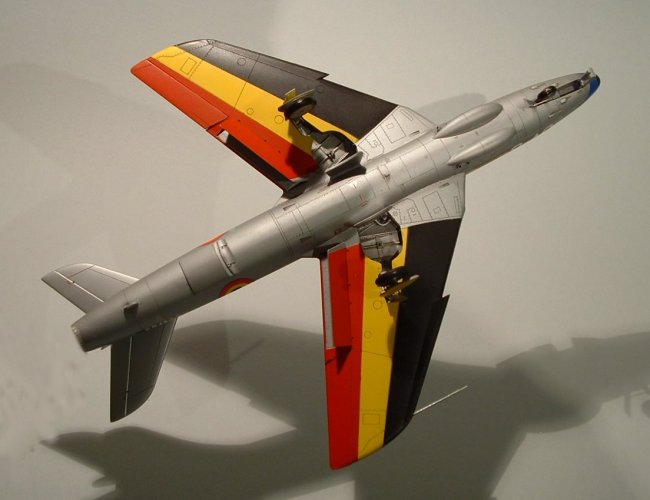
camouflaged aircraft are believed to have been painted with “belgian
wings”: two from n° 7 squadron ( red paperdoll insigna- squadron code
7J) and two from n° 8 squadron ( blue paperdoll insigna- squadron code
OV). Maybe there were more aircraft painted but I couln’t find any
evidence of that and Col.Bladt didn’t remember anymore By looking in
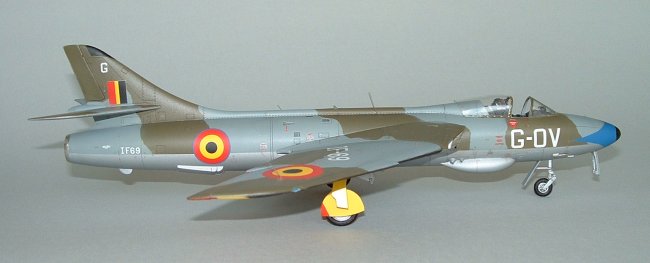
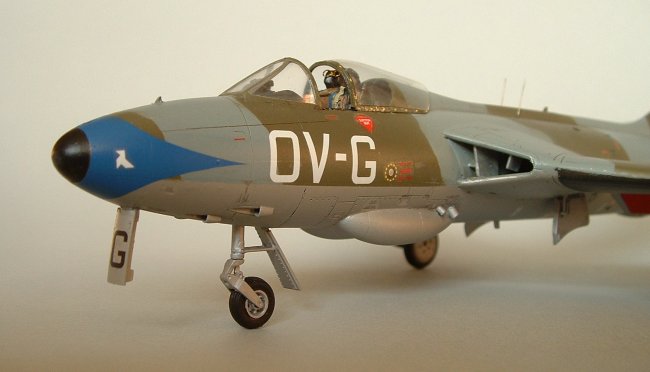
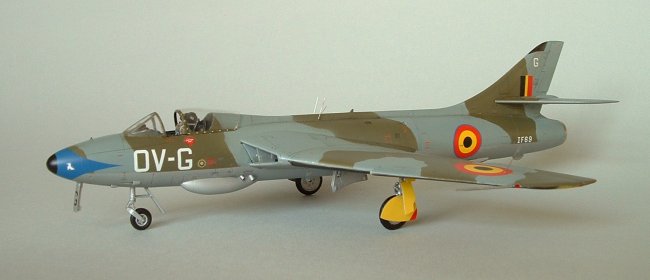
the log book of Bobby Bladt, Hawker Hunter Mk 6, IF-69 code OV-G was
deliberately confirmed as one of those specialy painted aircraft, as he
flew it several times during aerobatic practice and shows. Many in
flight pictures from that time taken by a RF-84F Thunderflash of n°42
squadron show IF-69 practising aerobatics with 3 others Hunters of 7th
wing , another one from n°8 sqn (IF- 13) and two others from n°7 sqn (
IF-80 & IF-93) . These are believed to be the
three others but it is not confirmed. I also found a small sketch ,
published in a BAF magasine of the early sixties, showing a 3 view
drawing of IF-69
|
|
The Academy
Hunter 1/48
Many
things have already been written about the Academy 1/48 Hawker Hunter, so I will
restrict myself . By reading the (very humoristic) article about the
"red" Red Devils Hawker Hunter by Erwin Boone in Arc Gallery, you will
have a good idea of the difficulties you will encounter while modelling this
kit. For my model I used some aftermarket kits like the one from Aeroclub and a
resin cockpit from KMC. The major points to look at are:
|
1.
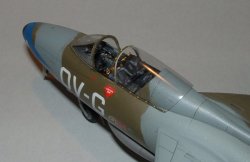
The ejection seat is undersized and should absolutely be replaced.
The Martin Baker MK2 or MK3 seat is currently available from various
manufacturers. General color of Hunter cockpit is mostly black
2. The
KMC resin kit I used wouldn’t fit easily
and needed a lot of sanding. I would rather recommend the Aeroclub
cockpit bathtub.
3.
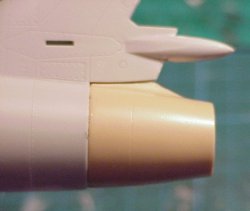
The Aeroclub kit provides new correct exhausts for the Mk4 or Mk6
variants
These need to be
filled in .The metal ring gives a nice touch when polished as
on real airplanes.
4.
The tailplanes should be positioned some 2,5mm forward and the cone
bullet
shortened
by 3 mm .
5.
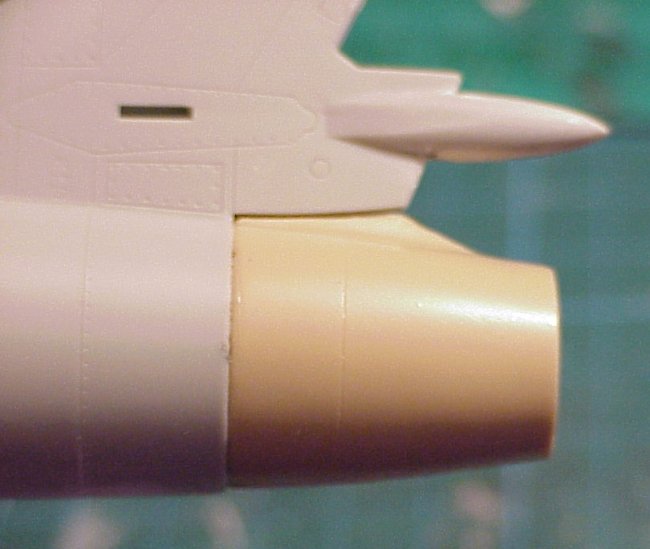
The wing construction is a real nightmare and unfortunately ends
with an ugly
seam line on the
fuselage at the intake entrance which doesn’t exist on real
planes and is
very difficult to hide ( putty or intake
covers give a solution)
I saw it to late
for my model). I do not know what the best method is to
assemble this
tricky part of the model. A lot of reinforcement ,super glue and
putty was needed
to have a good fit. If
I had to make another model, I think I
would glue the wings on the
fuselage halves
first before assembling
the fuselage and
the intake trunk. |
|
6.
The main wheel wells should easily benefit from some more plumbing
details
7.
Some panel lines should be rescribed at correct place- see a good 3
view drawing or actual aircraft pictures.
8.
I replaced my canopy with the vac-form one from Aeroclub. Here I
made a beginner’s mistake: I separated the windscreen before adjusting
the vacform canopy to the model and this led to many difficulties. Finally
, I used the Academy front part and the Aeroclub rear canopy.
9.
I used the Aeroclub wheels as
the Academy ones are undersized. There is also something wrong with
the rear door of front fuselage as the retracting rods of the aft door
should be more upwards . Look at actual aircraft pictures.
|
Click on
images below to see larger images
|
 |
 |
|
Painting
Of
course I chose to model IF-69 , OV-G from n°8 squadron. Belgian Hunters were
painted in standard RAF camouflage of dark green and dark grey but with silver
undersurfaces. The paints were gloss but rapidly turned to semigloss in
service. Two variants of the dark grey were used: a “light “ dark grey,
more blueish in hue and a darker one. The light shade seems to have been used
in the beginning and most later aircraft were painted with standard Nato
colors and most often seen with Nato stencils. I choose to paint my model in
the lighter scheme as I had “visual” memories of the “light” dark grey
. It remembers me my Dinky Toys
Hunters and Javelin metal models I played with in my childhood.
The result is very pleasing and in accordance with my souvenirs.
DACO
provides all that is needed to paint this aircraft : the decals and the
paints.
I
would recommend to follow the
instructions of DACO about the thinners as I had some problems with the paints
, thinned with normal white spirit, who didn’t dry. The decals are among the
best I have used. Note that the paperdoll insigna was only painted on the port
side .The “belgian wings” were standard black, yellow, red paints from
Humbrol.
The
model was lightly weathered as the Hunter was a rather clean aircraft . A
final coat of microcoat satin gave the final touch to the model.
To
conclude, it is not a bad kit and certainly stands out as a good Hunter but it
needs some patience and method to get those “damn...” wings right. The
"belgian wings" gave a bright touch of color to a standard
camouflage and makes a nice diversion from gaudy aerobatic team schemes.
I
hope You enjoyed it.
Bob
B/W picture courtesy
of BAF PR ; Badge courtesy Col. R.Bladt.
|
|