|
Here
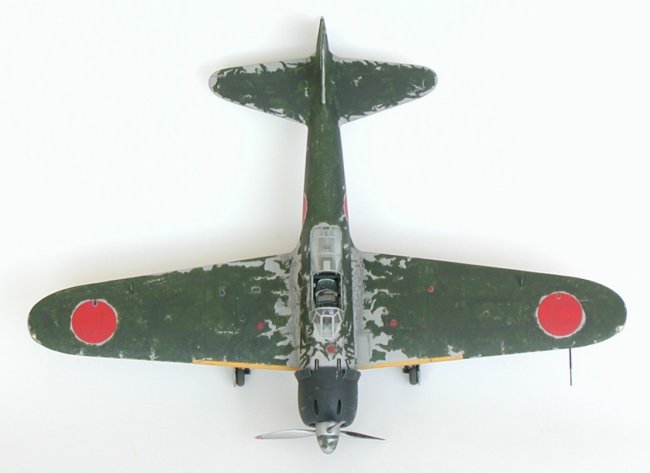
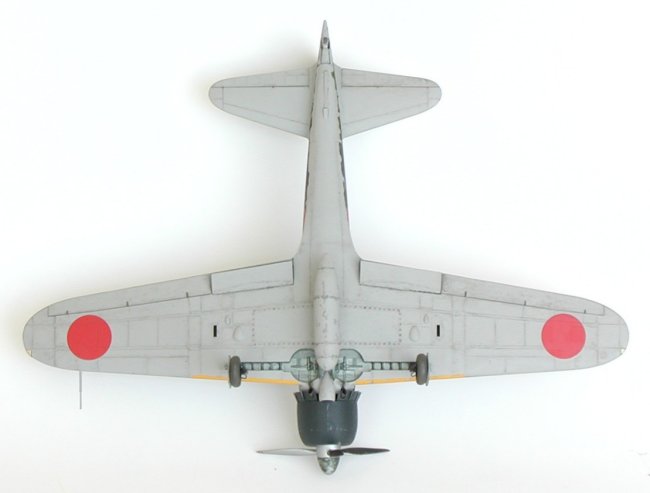
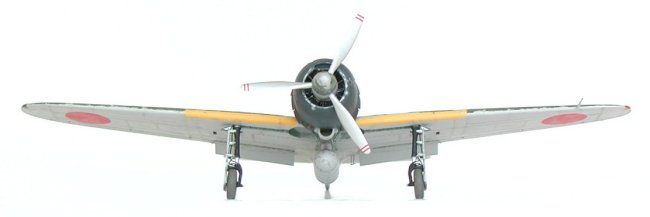
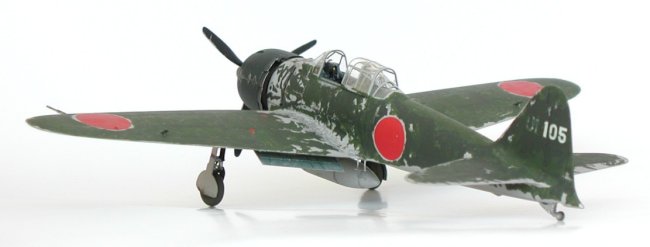
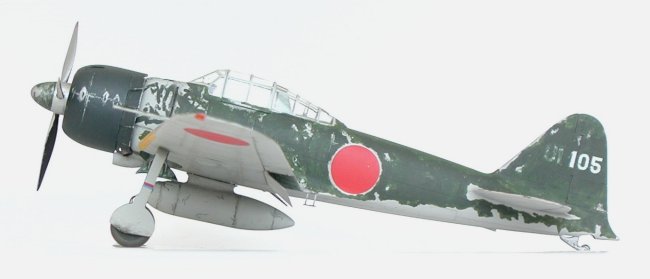
is my attempt to build a kit of Hiroyoshi Nishizawa’s Mitsubishi Zero A6M3
model 22.
For more info about Zeros visit this page: http://www.chuckhawks.com/best_fighter_planes.htm
Nishizawa
is on the top of all Japan Naval and Army fighter aces. There is no clear
evidence about his exact final score. Officially, he has 34 confirmed individual
victories. But after his death Nishizawa’s
family was informed about his 147 victories. Saburo Sakai, another Japan top
fighter ace, agreed with number 102. And finally, when Nishizawa left 253rd
Kokutai in Rabaul, he told to his commander Okamoto about 87 victories.
Nishizawa
flew the Zero as a fighter escort during the first official Kamikaze attack on
25 October 1944. USS Saint Lo was sunk, several other ships were damaged.
Nishizawa died the next day on 26 October 1944, in the age of 24 years, when he and
other pilots flew in the bomber back to Luzon after the attack and the bomber was
shot down by Hellcats from USS Wasp.
The
kit is the second aircraft in my collection of the WWII top fighter aces that I started
approximately 3 years ago.
|
Click on images below to
see larger images |
 |
 |
The
kit
The
kit is the Hasegawa Zero in 1:48. PE parts from Eduard were
added to the cockpit. Painted cooper wires represent brake lines. Open parts on
the engine cowling were cut from a beer can.
For
me the most important criteria is how the kit looks on the shelf. So I would
rather spend my time by the gathering info about the right camouflage and marking then
checking the kit dimensions, surface panel lines etc. against blue prints.
Assembling
I will
avoid description of the kit assembling, how parts fit etc. as it was a long
time
ago and I do not remember all details.
|
Click on images below to
see larger images |
 |
 |
Painting
and Marking
Original
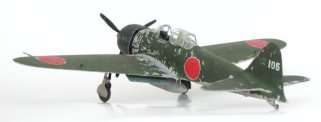
camouflage was light grey. Dark green on upper surfaces was officially used
since mid 1943. New planes were painted already in factories, operating planes
were repainted on their actual bases. I do not have any info about the
technical background in Rabaul, mid 1943, but seeing the picture of the Nishizawa’s
plane flying in the formation with other Zeros, I quess, that the dark green
color was probably hand painted, not airbrushed. So I tried to apply the
same technique.
The
basic light grey, FS-36493, on the external surfaces was airbrushed. Japanese
national insignia decals were applied and then one coat of the semigloss finish was
airbrushed. After it was dry the first layer of the matt dark green was hand
brushed and code letters UI 105 decal, created from my spares box were applied. Only
below the code letters decal was a gloss finish applied to avoid
silvering. Then one
coat of matt finish was airbrushed. And finally another layer of the matt dark
green with a little bit of black added was hand brushed. The idea was, that on
the original aircraft this second layer should restore abraded first dark green
layer painted onto dirty light grey. So I repeated it on my kit. The code
letters UI were very slightly overpained.
The
engine cowling was painted black with a little bit of blue added and coat
of semigloss finish was airbrushed.
All
interior surfaces such as cockpit, landing gear wells etc. were painted aluminium a then
a coat of thinned semigloss finish mixed with a bit of blue and green was
painted.
I used
Humbrol and Revell enamels.
Weathering
All
weathering is brushed using a very thinned mixture of matt Sand, Dark Earth and Black
enamel with the required ratio. Some areas had more brown, elsewhere more black.
I like
this approach because it makes the kit surface not so homogeneous.
Taking
Photos
All
pictures were taken on the balcony during a sunny day. The kit was placed on
the A1 white paper sheet. The first shots were taken in the direct sun light,
but the kits were too dark because of the white background and my limited
abilities to use all features of the borrowed digital camera. Then I tried
to placed them into the shadow and take some pictures in the indirect light.
After short experimenting I was pleased by results. Plane looked quite
well for me and, moreover, there were no sharp shadows of the plane on the
background.
References
·
REVI
Magazine, issue 8, 1995
·
http://www.warbirdsresourcegroup.org/IJARG/nishizawa.html
I hope
you will enjoy them.
Misos
Michal
|