|
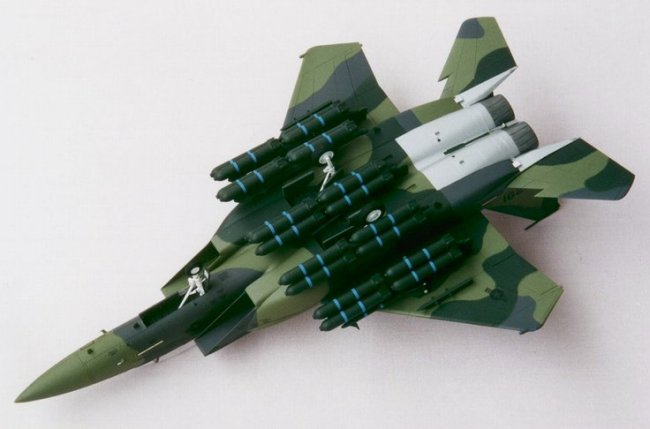
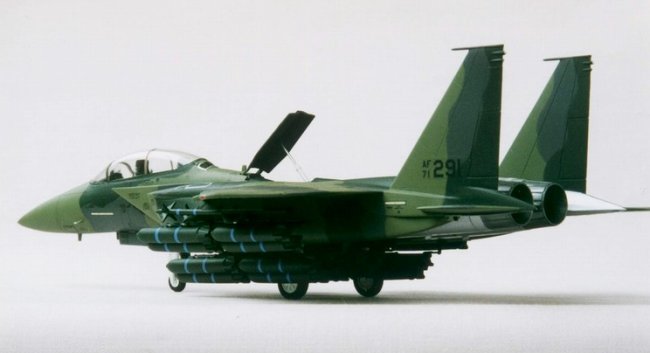
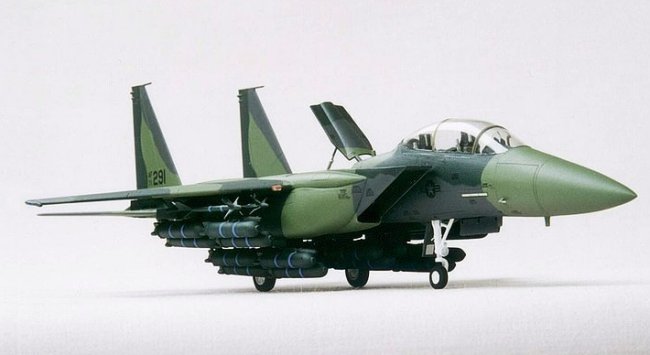
It is a rare seen assembled kit in
spite of it is one of famous F-15s. The question is F-15B-4-MC 71-0291, or –
simply – ‘291’, when it was the Strike Eagle Demonstrator.
So, it is Hasegawa’s kit No. E10 or 00540 in the 1/72 scale, an old
press-form moulding, reboxed in 1999.
In a sense, I have made this model ‘by mistake’. I collect military jets
only. But ‘291’ is owned not by the USAF, but by McDonnel
Aircraft Company. In this sense, it is a civil aeroplane with USAF insigna
and armament. But it is a very significant airframe in the history of F-15
fighters. It made its first flight on 18.10.1973 as a part of Category I
Contractor Development, Test and Evaluation testing. The airframe was used
many years for a great variety of tests and presentations. It also
received at least a dozen of paint schemes. And as the Strike Eagle
Demonstrator, it was tested in 1980-1983 at Edwards Air Force Base.
I have chosen that exact period for the following reasons. First. It
allows to apply the European One camouflage scheme. Second. It allows me
to use an extremely high quantity of external armament. In that case I
have attached 22(!) Mk.20 Rockeye cluster bombs looking themselves together like
a cluster in this case. Also two empty outboard wing pylons very rarely
seen on F-15's. All of that are in the kit (and it was a third reason).
The Hasegawa’s kit has raised
panel lines. And I have rescribed and corrected most of them except the
bottom part of the fuselage (the panel line sin this area can't be seen due to
the cluster of Rockeyes). I also corrected the geometry of the tail beams
and fins. Please note!: the top of portside and starboard vertical
stabilizers should be identical, i.e. without electronic equipment on the
portside (the kit’s instruction tells to mount different vertical stabilizers
as on most of F-15s - this is incorrect).
|
Click on images below to
see larger images |
 |
 |
Nevertheless, the main mistake of
the kit is a big airbrake. As on all of the first 20 test aircraft including
‘291’ has small 20-square-foot speed brake. I made appropriate changes
to the kit to reduce the airbrake. It wasn’t a difficult task. Some
problems were corrected on upper surface. In particular, I have built up
the longitudinal ‘hump’ (or ‘reversed chute’) on the airbrake and behind
it. It is a feature of the first production Blocks of F-15's.
I have decided to finish ‘291’
not in ‘exhibition’ standard but ‘for myself’ again. Therefore I have
added few only details to the kit ones. Particularly, I have made red
anticollision lights, incidence probes, Pitot heads. I have finished
‘291’ in appropriate colours of European One (or Charcoal Lizard) camouflage
scheme: Humbrol 149 as US Dark Green FS34092, Humbrol 117 as US Medium Green
FS34102 and Humbrol 32 as Dark Grey FS36082. It was added Humbrol 130
White to Dark Grey and Medium Green to achieve a necessary scale effect.
To my regret I didn’t add White to Dark Green (I used an old enamel looked too
light before drying and quite dark after that; therefore Dark Green is looking
somewhat darker than I would like to achieve on the model). But from my point of
view, it was not a reason to repaint the model. The area of the engines
was finished by Xtracolor 502 Natural Steel.
Sergey
|
|