|
A
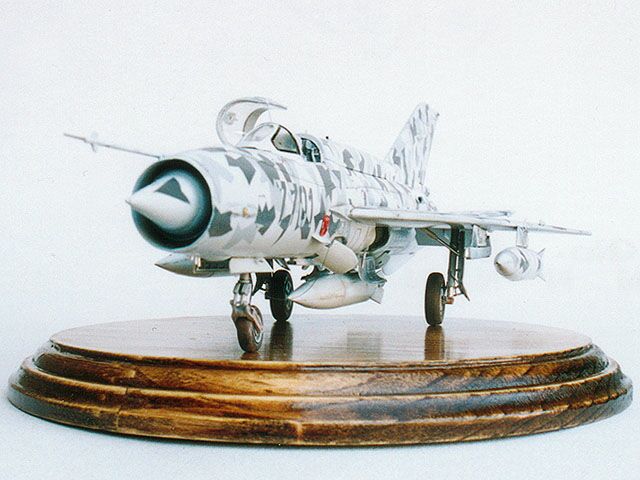
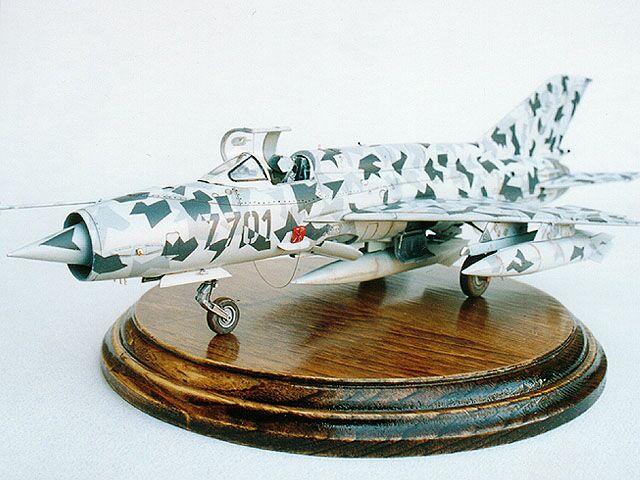
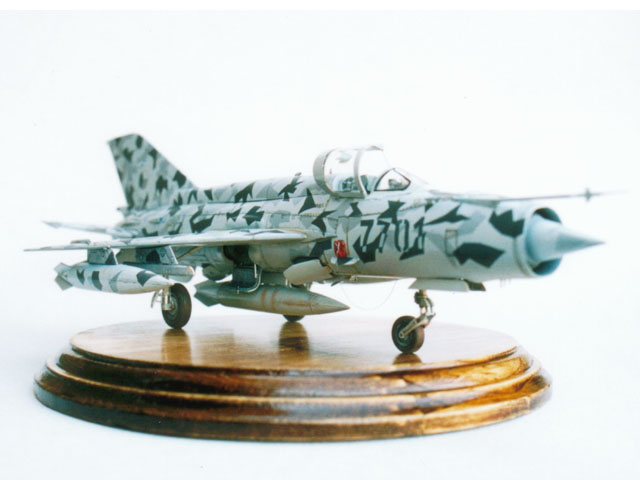
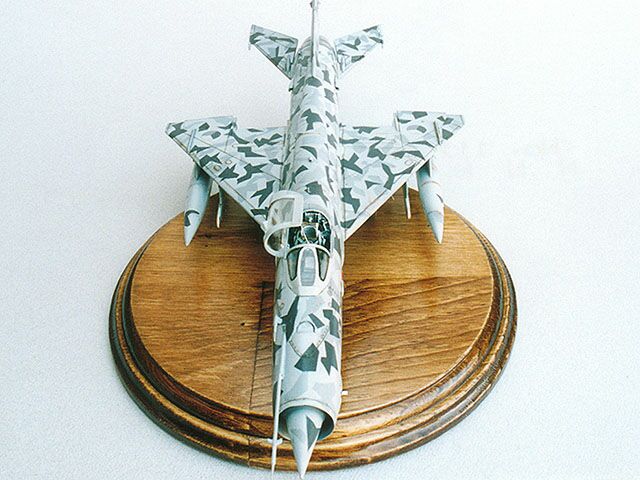
Mig-21 MF pretending to be a bis, pretending to be a MF
There
are two prevailing mindsets toward delta wing designs: those who appreciate the
beauty of its geometric symmetry and others with an aversion for its utilitarian
design. As one of the latter, building a Mig-21 never entertain my thoughts.
That
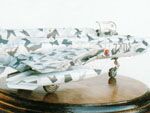
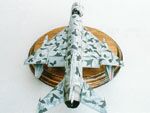
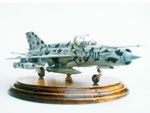
is until I chanced upon photos of a Czech Fishbed-J sporting a distinctive
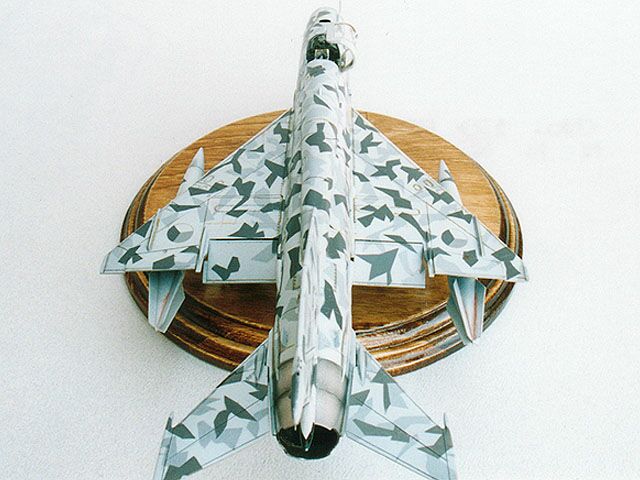
presentation scheme. There is something insanely wondrous about splinter
camouflage patterns. It is like seeing a cubist painting off canvas. The only
way to purge the image from my mind is to build that d@#и Mig.
| Several
modelers have pointed out that Academy’s MF (forsirovannyi,
modifitsirovannyi)
kit
is in reality a model of the later Mig-21bis (improved). The most
perceptible difference between the two interceptors resides with the shape
of their dorsal spines. Since my desire was to replicate the Czech
aircraft, returning the model back to a MF became essential. As it turns
out, it is very simple to alter the model as the image (right)
demonstrates.
|
| Click on
image below to see larger image |
 |
|
Resin Cockpit
|
|
To
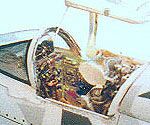
dress up the model, the kit’s cockpit parts were discarded in favor of
NeOmega’s resin update. The level of detailing on all 8 parts is truly
amazing. It would even make a beautiful standalone kit if enlarged to 1:16
scale.
|
|
Dry
fitting revealed that the KM1 seat sits too far forward in the tub. Filing
off a small portion from the lower rear of the seat alleviated the tight
fit. Thin wire and old PE parts from the scrap box were added to simulate
the ejection handle & leg restrains.
|
|
Masking
and Painting
With
the alterations and construction done, the next task is to find the simplest
masking/painting method for the hard edge pattern. The answer finally came to me
after reading Helmet Latoschinski’s article in HyperScale describing what he
termed as Reverse
Mottling Technique.
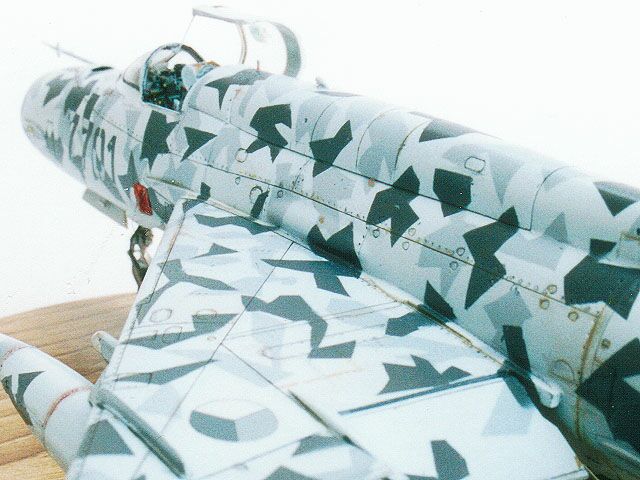
The
aircraft was first airbrushed with the topmost colour, in this instance dark
grey. It was stored in an empty cupboard for a week enabling the enamel paint
has fully cured within a dust free environment. Tape masks duplicating the dark
grey patches were then cut and placed on the model. Medium grey was then sprayed
and the process repeated until the painting was complete.
|

|
The
a/c number and national markings were edited on the computer, and then
laser printed as wire frame (outline) onto clear decal film. Using a Xacto
knife, the outlines of the decals were lightly scored without cutting
through the sheet. It was then airbrushed - one set of markings for each
colour. Finally the decals were individually applied on the model. It was
trimmed, while still wet, to match the splinter pattern.
|
Having
satisfied my desire to paint a splinter scheme, I now avoid photos of Mirages,
Darts, and Daggers. I’ve also come away with a genuine admiration for all
those modellers who painstakingly replicate the intricate pattern of the Swedish
Viggen.
Moses
| Click on
images below to see larger images |
 |
 |
 |
 |
 |
 |
Reference:
- The
Mig-21 Page – Contains mostly technical information.
- Russian
Aircraft Modeling
– Very useful information pertaining to the actual aircraft and model
information for the Fishbed and Eastern Block aircrafts.
|
|